Author of this article:Fiona
In the past few years, most small and medium-sized enterprises have fallen into the same trap: the more SaaS tools they buy, the higher the cost, but the efficiency has not improved synchronously. Customer service system, CRM, work order system, WhatsApp tool, marketing automation platform, statistical tool... Each is under the name of "just need”, but after it is really put into use, you will find that:There is a lot of overlap in functions, data is fragmented everywhere, processes are getting more and more chaotic, training costs are soaring, and profits are quietly eroded.
"It should be"Cost reduction and efficiency"The weapon has virtually become an invisible cost that devours profits. Therefore, small and medium-sized enterprises have to face an increasingly realistic and urgent question: how to truly reduce SaaS costs without sacrificing efficiency or even further enhancing efficiency?
To answer this question, we must first make it clear:Why do costs keep rising? Why are companies paying for it?
- 1. Why does the cost of SaaS keep rising? The 4 types of expenditures that SMEs are most likely to ignore
- 2. The core strategy of small and medium-sized enterprises to reduce SaaS costs: reduce the number of tools + automation to improve efficiency
- 3. Practical cases: How can ”integration + automation" help small and medium-sized enterprises reduce costs?
- 4. The real cost reduction and efficiency increase is not less money, but less complexity.
- FAQ
1. Why does the cost of SaaS keep rising? The 4 types of expenditures that SMEs are most likely to ignore
Most companies think they are “buying tools on demand”, but the actual situation is:Dispersion of tools → overlap of functions → duplication of manpower → doubling of costs.Below, we disassemble the four most typical types of invisible costs.
Many small and medium-sized enterprises think they are “buying SaaS tools on demand”, but as their business expands, they often fall into a strange circle of higher costs and lower efficiency. There are four essential reasons:
First, the more tools are used, the more they are used. Customer service systems, CRM, automation, data reports, etc. are superimposed, and the subscription fee far exceeds the original budget.
Second, the tools are scattered and not interoperable, resulting in repeated copying, pasting, derivation, and proofreading of customer service, sales, and marketing, and the cost of human collaboration is exponentially magnified.
Third, the more tools and the greater the team flow, the more frequent training and process reconstruction will be. It takes not money, but continuous time and stability.
Fourth, the processes are scattered in multiple tools, and the standards cannot be unified. The team can only rely on “people to remember the process and follow the progress”, and the decline in efficiency has become the biggest invisible loss.
The end result is: the more tools are piled up, the higher the cost, but the team efficiency is declining in reverse. This is why the trend of SaaS is bound to move towards Integration + automation ——Reduce the number of tools, reduce collaboration costs, unify data, and let AI take on repetitive tasks, so that enterprises can truly reduce costs and increase efficiency.
Therefore, the real cost reduction and efficiency enhancement is not to continue to make up more tools, but to return to a more fundamental issue.:How to make fewer tools, smoother processes, and lighter collaboration?With this core idea in mind, let's move on to the next part-from the perspective of the actual operation of the enterprise, dismantling how small and medium-sized enterprises can truly reduce the cost of SaaS by reducing the number of tools and automating collaboration.
2. The core strategy of small and medium-sized enterprises to reduce SaaS costs: reduce the number of tools + automation to improve efficiency
Cost optimization is not purely “cutting budgets”, but making tools truly serve the business. There are only two most effective strategies:
Strategy 1: Replace multi-tool decentralized management with an “integrated platform”
In the past, it was a typical “three systems and three processes” collaboration: customer service used one tool to reply, sales used another system to follow up with customers, and operations relied on a third tool for data monitoring. The more tools are bought, the more decentralized and chaotic the processes are. Cross-departmental collaboration requires constantly cutting systems, importing data, and posting information, which is not only a waste of time, but also makes the entire team feel seriously dependent on the system. A sense of dependence.
And throughIntegrated platformReducing the number of tools is the most immediate way. When the capabilities of customer service, CRM, automation, WhatsApp acceptance, advertising comment monitoring, data analysis, etc. are unified into the same system, the tool subscription fee will be immediately reduced by more than half. More importantly, the processes are connected together, the data is no longer fragmented, and cross-departmental collaboration does not require tools to jump around., Training has also become much simpler. The process only needs to be configured once, and the full link can be called. The team no longer relies on manual operations to fill vulnerabilities, and the complexity of the organization's operation is significantly reduced.
To Mixdesk For example, it is toCustomer service system + Social media aggregation tool + automation workflow + AI function + The data kanban board is integrated on the same technical base. Enterprises do not need to maintain multiple sets of logic, nor do they need to switch multiple tools. All processes are naturally linked: after the inquiry is entered, it is automatically filed, responded to, assigned, followed up, and labeled, and the whole link is as smooth as an assembly line.
In other words, integration is not to “save money for a tool”, but to change the entire organization from “relying on people to fill loopholes” to “relying on the system to run processes”. While the cost is reduced, the efficiency is higher.

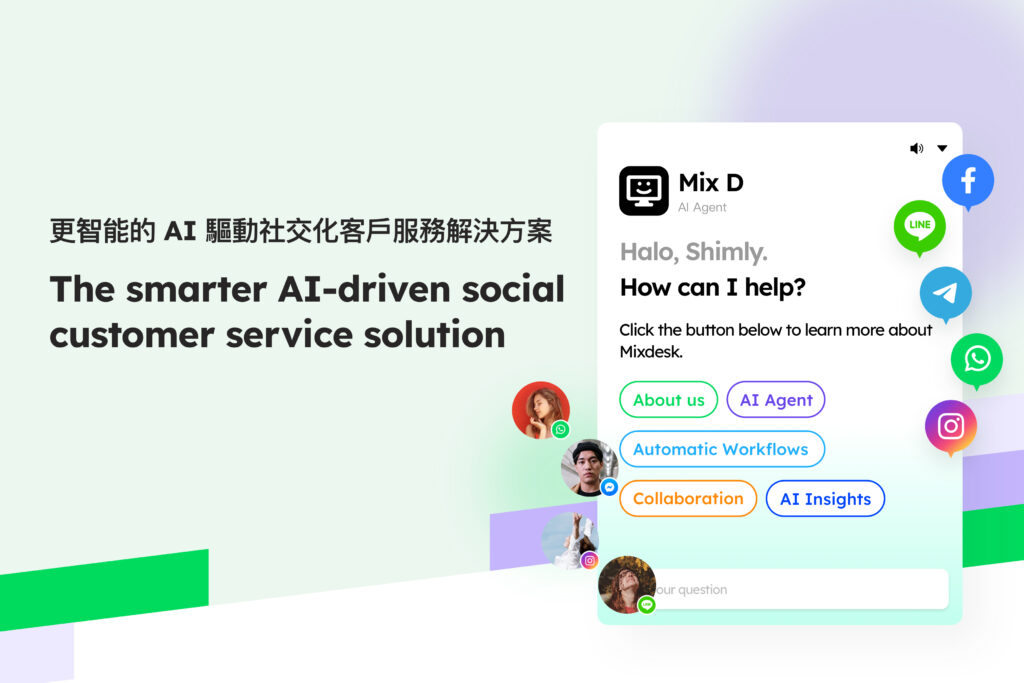
Mixdesk is an overseas multi-channel intelligent customer communication platform that can unify multiple channels such as Facebook, Instagram, WhatsApp, Line, Telegram, and Email to help companies communicate and serve customers. Mixdesk also supports AI employee functions, allowing enterprises to achieve more efficient automated customer service.
Strategy 2: Use automation to reduce repetitive labor investment
Whether it is customer service, sales or operations, there are a lot of repetitive, high-frequency, and logically fixed content in daily work: FREQUENTLY asked questions, marking customer attributes, distributing leads, quotation follow-up, proactive reach, and recording data.……
Mixdesk has built-in multi-dimensional data analysis + AI insight, real-time tracking of customer service operation and transformation data, and intelligent report output of key trends to help enterprises data optimize services and efficiency.
These tasks may not seem complicated, but they consume a lot of manpower every day. And this is where automation can best unlock value. With the help of automation and AI, companies can let the system handle repetitive actions, allowing people to truly focus on more valuable links. To Mixdesk For example, its AI + Workflow can do it:
- Second levelAutomatic reply 90% frequently asked questions
- Automatically identify customer intentions (such as inquiry/after-sales/complaint/high intent)
- Automatic hitlabel, Hierarchical management of customers
- Trigger quotes, follow-up conversations or reminders based on customer actions
- Determine whether manual takeover is required based on confidence
- Automatically transfer to manual after identifying potential business opportunities to ensure that key customers are not missed
Automation not only reduces the team's investment in repetitive tasks, but also significantly improves response speed and customer experience. The team is no longer suppressed by basic communication, but can devote its energy to high-intent customers, complex consulting, and key decision-making, allowing enterprises to gradually transition from “relying on people to build efficiency” to “relying on the system to run efficiency”.
The meaning of automation has never been to “replace people”, but to “keep people from being dragged down by trivial work.”
3. Practical cases: How can ”integration + automation" help small and medium-sized enterprises reduce costs?
The following is a real landing case in the cross-border e-commerce industry. The protagonist of the case is a 15-person cross-border 3C merchant in Shenzhen (mainly in the European, American and Southeast Asian markets). The core products are wireless earphones, chargers, etc., with annual revenue of about 8 million U.S. dollars. Previously, it was plagued by the cost of redundant tools and fragmented processes.:
Status quo ante: chaotic and expensive, the whole team is in an ”invalid state"
- Redundant tools and high costs: Long-term use of 6 sets of independent tools, the total monthly tool expenditure is fixed at about US 1 1,200, and the SaaS cost alone is US 1 14,400 a year.
- Data is split, and collaboration depends on "manual relay”: The data of the 6 sets of tools is completely impassable, forming an “information island”.
- The proportion of repetitive labor is extremely high: Employees spend 60% of their time on meaningless repetitive labor every month, which is extremely inefficient.
- It is difficult for newcomers to get started and the training cost is high: It takes 1 month for newly recruited customer service to be proficient in operating 6 sets of tools, and it is easy to make mistakes in the initial operation process due to confusion; when core employees leave, they will take away their tool operation skills, and the new person who takes over will have to re-explore, and the cost of process reconstruction will increase implicitly.
After upgrading to integration through Mixdesk: the process is reshaped and the cost is directly reduced
- Tool "slimming": 6 sets →1 set, the cost is saved by 52%:Mixdesk One-stop integration of 6 core functions of customer service communication, CRM customer management, WhatsApp multi-account operation, automated response, real-time reporting, and work order flow, no need to subscribe to other tools. With an annual payment of US 11,908, the SaaS cost is directly reduced and nearly US节省10,000 is saved.
- Increased response speed and doubled customer experience: All channelsdataReal-time synchronization, whether customers consult through WhatsApp, Facebook or independent stations, customer service is at Mixdesk A complete customer portrait (including historical orders, consultation records, and labels) can be seen in one background. The response speed has been increased from the original 5 minutes to a second response, and the customer praise rate has been increased from 78% to 92%.
- Reduce manual workload and free up core energy: The automation function covers 80% of repetitive work-customers ask high-frequency questions such as ”logistics timeliness“ and ”inventory status", and the automated response responds in seconds; after-sales disputes automatically generate work orders and assign them to corresponding specialists according to the type of problem; there is also a real-time data board in the background, and the amount of consultation and service status are clear at a glance. open Mixdesk You can view real-timeoperationData, no need to wait for operations to organize reports, and the efficiency of decision-making is doubled.
- Newcomers get started quickly and the organization is more stable: A set of tools + standardized processes, the new customer service can operate proficiently in just 1 day, and there is no need to remember the operation logic of 6 sets of tools; all processes are automated and visualized, and the team operation no longer relies on “tool proficiency”, even if the core employees leave, the new receiver can quickly connect through the background process records., Training costs and process reconstruction costs were reduced by 70%.
Mixdesk
AI Agent
More importantly:The profit margins of enterprises have been significantly improved and are no longer “eaten up” by tool costs.
These changes not only directly convert cost savings into profits, but also make business operations stable, controllable, and replicable. After there are fewer tools, newcomers can get started faster, and the training costs and process reconstruction costs brought about by team mobility are greatly reduced. The organization no longer relies on a few “tool masters”, but becomes a process-based and automated system. These long-term savings are even more valuable than the cost of the tool itself. Even if you expand your team and open up new markets in the future, you can quickly replicate the existing operating model without having to spend additional costs on tool adaptation and process reconstruction. For small and medium-sized enterprises, this “stable, controllable, and replicable” operating system is far more valuable in the long term than short-term cost savings.
4. The real cost reduction and efficiency increase is not less money, but less complexity.
For small and medium-sized enterprises, the future competition is not “who uses more tools”, but “who has smoother processes, lighter cost structures, and faster response.” By reducing the number of tools, unifying data links, and usingautomationTaking over repetitive labor, enterprises can use less manpower to run more efficiently, and use fewer systems to support larger-scale business growth.
True cost reduction and efficiency enhancement are to reduce complexity, reduce duplication of labor, and reduce cross-system friction, so that the team can devote more time to truly creating value. There are fewer tools, more stable processes, and stronger automation. This is what small and medium-sized enterprises should move towards. SaaS Optimize the direction.
Use Mixdesk AI customer service system: reduce costs and save money, improve efficiency and fill up
With the help of Mixdesk, one-click deployment of ChatGPT/DeepSeek-blessed AI customer service, custom speech techniques, replacing 70% + basic consultation; data insight + one-stop operation in the background.
FAQ
Q1: We are already using multiple tools. Does integration mean that we have to "tear it down and start over”?
A: No. Integration does not require replacing all systems at once. Mature platforms (such as Mixdesk) usually support one-click import of customer data, multi-channel access, and gradual migration. Enterprises can access from a certain business line and then gradually expand without interrupting existing business processes.
Q2: Will integration sacrifice functional depth?
A: No. The modern integrated platform does not “put together” multiple tools, but deeply integrates core capabilities such as customer service, social media channels, automation, reporting, and AI response under a unified technical framework. On the contrary, the functional depth and stability are higher than the multi-tool combination.
Q3: Will automation affect the customer experience?
A: No. High-quality automation, taking Mixdesk as an example, has intent recognition, contextual understanding, situational judgment, and a “confidence-to-labor” mechanism, which can be automatically processed where it can be automatically, and handed over in time when labor is needed. Not only to ensure the efficiency of response, but also to retain the temperature and professionalism of communication.
Q4: Is automation suitable for small and medium-sized enterprises with complex businesses?
A: Very suitable. The more complex the business, the more repetitive actions, and the longer the collaboration chain, the more obvious the value of automation. Automation does not change your business logic, it just hands over those high-frequency, clear rules, and easily missed links to the system for stable execution.
Q5: Data is concentrated on one platform, is there a security risk?
A: No. Professional platforms (such as Mixdesk) adopt an enterprise-level security architecture, including full-link encryption, AWS financial-level cloud storage, refined access control, operation traces, automated risk audits, and fully comply with privacy regulations such as the EU/CCPA. At the same time, through a transparent data purpose declaration and authorization mechanism, the data of enterprises and customers is always within a controllable security range.