Author of this article:Fiona
In today's highly fragmented customer contacts, customer service tools are no longer just auxiliary software for “receiving messages”, but have gradually evolved into an important infrastructure for enterprises to connect customers, precipitate data, improve efficiency, and ensure compliance.
Whether it is a cross-border e-commerce company, a SaaS service provider, or a sales-driven growth company, almost all will face the same problem at some stage.:How to choose a set of customer service SaaS platform that really suits you?
In the actual selection process, many teams are not devoid of energy, but are prone to the following common misunderstandings::
- Led away by the function list: It looks like “everything is available”, but there is not much ability to use it at a high frequency.
- Only focus on price or short-term demand: Ignore the complexity of team expansion and multi-channel access
- The more tools are used, the more data is scattered.: Customer service, sales, and customer data are dispersed in different systems, which increases management costs.
- Easy to go online, difficult to manage: Lack of authority, collaboration, and data precipitation capabilities, and long-term operational pressure is constantly increasing
To avoid these problems, the key is not to “choose the tool with the most functions”, but to return to the core logic of selection-from the perspective of long-term operation and large-scale development, evaluate those key indicators that truly determine the value of the tool. Indicators.
This article will start from a practical point of view and systematically sort out the evaluationCustomer service SaaS platformThe core dimension that cannot be ignored at the time helps companies make more robust and sustainable decisions among the many choices.
- 1. Whether it has the ability to “unify and carry”, rather than a simple overlay function.
- 2. Whether customer data is truly precipitated into “corporate assets”
- 3. Is the authority and role system clear and flexible enough?
- 4. Whether data analysis is practical
- 5. Whether it has the ability of automation and intelligence
- 6. Whether to support business expansion instead of limiting growth
- 7. Whether compliance and security are “internalized” into the system
- Summary: Choosing tools is essentially choosing a set of long-term management methods
- FAQ
1. Whether it has the ability to “unify and carry”, rather than a simple overlay function.
In the early stage of selection for many teams, the most intuitive judgment criterion is “how many channels to support”. But what really matters is not the number of channels themselves, but the number of channels.Are these channels beingUnified management。 A mature customer service platform should be able to integrate messages, customer information, and interaction records from different channels into the same workflow and data system, rather than superficial access and underlying fragmentation.
When evaluating, you can focus on the following issues:
- Whether conversations from different channels enter the same reception queue
- Can the customer be identified as “the same person” instead of multiple isolated sessions?
- Is the historical communication record continuously available?
- Does it avoid frequent switching between multiple back offices by employees?
like Mixdesk Such platforms that emphasize “unified dialogue hubs" essentially solve not only the problem of the number of channels, but also allow multi-channel services to operate under the same set of views and rules.
Use Mixdesk AI customer service system: reduce costs and save money, improve efficiency and fill up
With the help of Mixdesk, one-click deployment of ChatGPT/DeepSeek-blessed AI customer service, custom speech techniques, replacing 70% + basic consultation; data insight + one-stop operation in the background.
2. Whether customer data is truly precipitated into “corporate assets”
The value of customer service tools does not stop at the current communication efficiency, but also lies inCan customer data be deposited in a long-term and safe manner?。 When selecting models, companies need to clarify a question: does customer data “exist in the system” or “in the hands of employees”?
It can be judged from the following dimensions:
- Whether customer information and chat records are stored centrally in the enterprise background
- Whether the data is bound to a personal account, device, or employee
- When an employee leaves a job and the account number is abnormal, is the data still complete and available?
- Whether to support structured precipitation of customer labels, remarks, historical tracks, etc.
It is worth noting that some mature and reliable platforms (such as Mixdesk) Not only does it support complete retention of interaction records,Even if the message is deleted or withdrawn, the history can be retrieved in the background, Avoid the loss of customer assets due to personal operations from the source, so that customer data can be separated from personal habits and become a long-term asset that the enterprise can control and trace.
3. Is the authority and role system clear and flexible enough?
Many customer data risks do not come from external attacks, but from internal permissions and operating processes that have been in an “invisible and uncontrollable” state for a long time. Therefore, when evaluating the customer service SaaS platform, we should not only look at the statistical results, but also pay attention to whether the platform hasClear authority boundaries and complete process marking ability。
Mature platforms (such as Mixdesk) Support refined role and authority management, divide the visible scope and operating authority by position, and restrict and record high-risk behaviors such as export and deletion, instead of the default “everyone can see and change”. At the same time, all service behaviors themselves should also be traceable. Not only can you see the final result, but you can also restore the whole process of the problem.
In the actual evaluation, you can focus on:
- Whether to support fine-grained role and permission settings, and keep a complete operation log
- Whether the customer dialogue is completely preserved, and whether it supports historical backtracking
- Whether to record every reply, transfer, and processing path
- Whether to support internal remarks, collaboration traces and basic quality inspection capabilities
When the boundaries of authority are clear and the process records are complete, management judgments can be based on facts rather than experience, and the quality of service is easier to maintain long-term stability.
4. Whether data analysis is practical
Mixdesk has built-in multi-dimensional data analysis + AI insight, real-time tracking of customer service operation and transformation data, and intelligent report output of key trends to help enterprises data optimize services and efficiency.
Many SaaS platforms emphasize “rich data reports”, but in actual use, what is really valuable isData analysis, Often have two characteristics:Can understand and act。 When choosing a model, you can judge from the perspective of practicality.:
- Whether the indicators are related to actual business goals
- Whether to support splitting by member, role, and channel
- Can managers quickly locate bottlenecks or anomalies?
- Can the data be used to adjust subsequent strategies?
If the report is only used for display and cannot guide decision-making, then no matter how exquisite the chart is, the value is very limited.
5. Whether it has the ability of automation and intelligence
With the growth of team size and dialogue volume, relying solely on manual processing, sooner or later you will encounter efficiency bottlenecks. Therefore, in the selection stage, we should pay attention to whether the platform hasautomationand AI abilityThe extension space.
For example:
- Whether to support regularization and automatic distribution to reduce order grabbing and omissions
- Can automated processes be used to undertake high-frequency basic issues?
- Can AI assist in generating replies and summarizing customer demands?
- Can you identify high-intent sessions and access manual customer service in time?
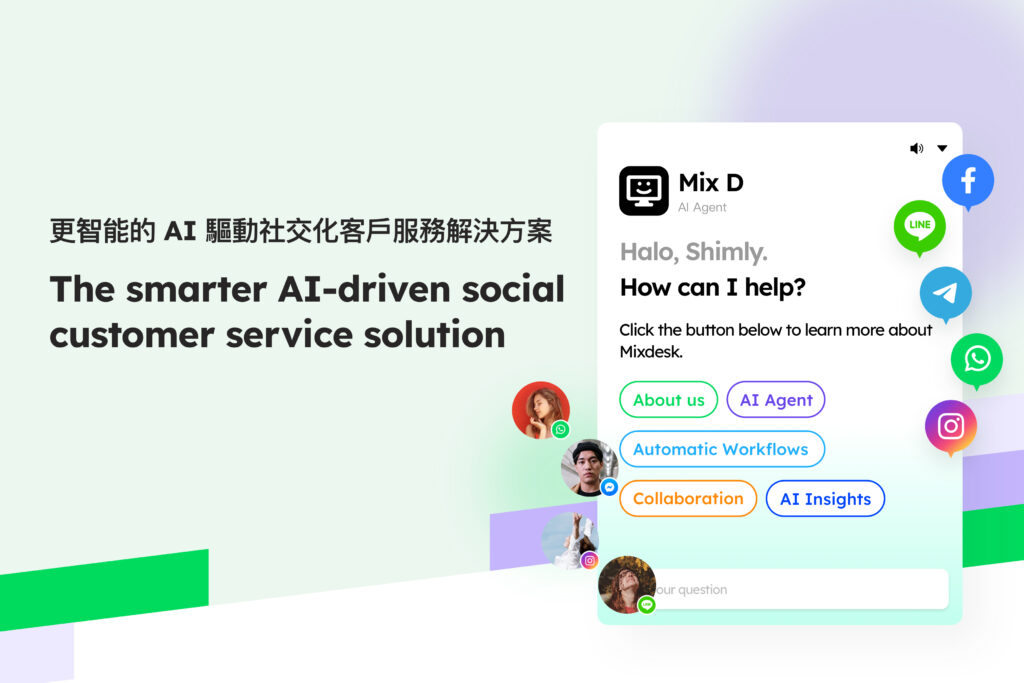
To Mixdesk For example, its AI capabilities are not a substitute for labor, but through AI to undertake basic consultation, assist in judging intent, and automatically turn to labor, allowing customer service to focus on high-value scenarios that really require judgment and communication. This kind of ”human-computer collaboration" ability often determines whether the platform can support the growth of the next 1-3 years.
Mixdesk
AI Agent
6. Whether to support business expansion instead of limiting growth
Customer service tools tend to grow with the business. If the platform itself has obvious limitations on extensibility, the cost of late migration will be very high. When evaluating, it is recommended to pay attention to:
- Whether to support adding accounts, teams, and channels
- Multi-market、Multilingual, Whether multiple time zones are available
- Whether the authority and process can be adjusted according to changes in the organization
- Is the performance stable after the data scale is expanded?
Some platforms that target users of growth companies (such as Mixdesk), Multi-team, multi-channel parallel scenarios are often considered at the beginning of the design, which can avoid frequent “system changes” in the expansion phase of enterprises.
7. Whether compliance and security are “internalized” into the system
In the context of increasingly stringent privacy regulations, compliance capabilities have become the basic requirement of customer service tools, not an additional item. When evaluating, it should not only stay on the slogan of “compliance”, but should pay specific attention to:
- Is there a clear boundary between data storage and access?
- Whether to support operation marking and audit
- Can it assist companies to meet the compliance requirements of different regions?
- Whether to reduce the compliance risks caused by manual operations
Mature platforms often make compliance basic through permissions, processes, and logging mechanisms. This is also the choice of many companies Mixdesk One of the important reasons for the professional system.

Mixdesk is an overseas multi-channel intelligent customer communication platform that can unify multiple channels such as Facebook, Instagram, WhatsApp, Line, Telegram, and Email to help companies communicate and serve customers. Mixdesk also supports AI employee functions, allowing enterprises to achieve more efficient automated customer service.
Summary: Choosing tools is essentially choosing a set of long-term management methods
The selection of the customer service SaaS platform is not essentially choosing a software with the "most functions”, but choosing a set for the enterprise.Long-term sustainable customer management。
In the short term, the tool solves the problem.efficiency;
In the medium term, it affects team management and service quality.;
In the long run, the decision is whether customer data is safe and the business is replicable.
When an enterprise shifts from ”functional comparison“ to ”system evaluation“, from ”current needs“ to ”the next three years", the direction of selection will naturally become clear. Customer service platforms that are truly worth investing in often have such a common denominator:
Let complex communication become orderly, let management move from experience to data, and let growth be based on a controllable and stable foundation.
FAQ
Q1: Is it necessary for a small team to choose a “professional” customer service plan from the beginning?
A: It is necessary, even more valuable. Many problems of data confusion and out-of-control permissions often occur when the team is still small, such as multiple people sharing accounts and customer information scattered in personal tools. Once the business grows or people move, these hidden dangers will be rapidly magnified. The sooner a unified dialogue hub and data precipitation mechanism are established, the lower the cost of later expansion and management.
Q2: What is the essential difference between customer service SaaS and ordinary chat tools (such as WhatsApp and Corporate WeChat)?
A: The core difference lies in "whether you have management capabilities”. The chat tool solves the "communication itself”, while the customer service SaaS solves the collaboration, authority, data, and process issues behind the communication. Whether it can uniformly carry multiple channels, precipitate customer data, realize the division of roles, and support resale and analysis determines whether the tool can support large-scale services.
Q3: Where is the actual value of AI in customer service SaaS?
A: It lies in amplifying the overall efficiency. The AI of mature platforms is more used to undertake high-frequency problems, assist in identifying customer intentions, automatically divert and summarize information, and allow manual customer service to focus on high-value communication. This human-computer collaboration model can support a larger scale of services without significantly increasing manpower.
Q4: How to judge whether a customer service SaaS is suitable for ”long-term use"?
A: See if it is helping you "reduce complexity”. A platform worthy of long-term use should make communication more orderly, management more controllable, and data more centralized as the business grows, rather than increasing the number of systems and process complexity simultaneously. If the tool itself is amplifying the management burden, it often means that there is a problem with the selection direction.