Author of this article:Fiona
In the era of “multi-channel, high-frequency, and strong experience” in customer service, the challenge facing enterprises is no longer “whether there is customer service or not”, butHow to make the scale of services bigger, more stable, and more consistent without increasing manpower indefinitely.
To achieve large-scale customer service, the core is not to "recruit more customer service”, but toWhether to establish an efficient teamwork system。 With the help of collaborative capabilitiesSystem tools(Such as Mixdesk), enterprises can allow a team to serve more customers, multiple platforms, and multiple time zones at the same time, and maintain stable service quality.
Next, we will disassemble from the system: why “teamwork ability” determines how far customer service can go.
- 1. Why is it easy for customer service to get out of control as soon as the scale is enlarged?
- 2. Solution: With collaboration as the core, build a scalable service system
- 3. The landing path of large-scale customer service
- Summary: The essence of scale is “the replication of collaborative capabilities”
- FAQ
1. Why is it easy for customer service to get out of control as soon as the scale is enlarged?
After the rapid growth of customer volume, many companies will encounter a similar confusion: there are more and more inquiries and customer service continues to increase, but the customer experience has not improved with it, on the contrary, it is more prone to errors. The problem often lies not in the ability of personnel, but in the way of collaboration that is still stuck in the “small team stage”.
The true scale of customer service is not simply "responding to more messages at the same time”, but maintaining a stable response speed, unified service caliber, and clear information flow while customers, personnel, and channels grow at the same time. To do this, we must rely on teamwork and system support.
But in reality, teams that lack collaboration mechanisms will soon be exposed.:
- Information is fragmented, and the cost of communication is constantly increasing. Customer issues that require multi-person collaboration are passed back and forth in different tools, and information is easily distorted and missed.
- The process is opaque and it is difficult for management to intervene in a timely manner. The dialogue is scattered in the hands of customer service, managers cannot grasp key conversations and risk nodes in real time, and quality monitoring lags behind.
- The division of labor is unclear, and multi-channel reception is prone to errors. In the multi-channel parallel scenario, it is prone to repeated replies, vague responsibilities, or high-priority issues being ignored.
These confusions are not accidental, but the inevitable result of the expansion of the scale. When customer service is still centered on ”personal processing", collaboration costs will be infinitely magnified as the business grows, ultimately dragging down overall efficiency and experience. To truly support large-scale services, teams must shift from individual tasks to systematic collaboration.
2. Solution: With collaboration as the core, build a scalable service system
When the scale of customers continues to expand, the upper limit of service capabilities no longer depends on how proficient a customer service is, but on whether the team is running in the same collaborative system. Truly large-scale customer service must allow information, responsibilities, and decisions to flow efficiently within the system, rather than relying on personal experience and temporary communication.
- Unified dialogue hub: Let all service behaviors "converge rather than disperse”
The first step in large-scale services is to eliminate channel barriers. A mature SaaS customer service platform should be able to incorporate customer messages from different sources such as WhatsApp, social media private messages, and official website chats into the same platform.Shared workbench。
Under a unified view, the team can grasp the overall service status in real time:
- Which customers are still waiting
- Which conversations have been taken over
- Which issues are being dealt with
System-level visibility allows “who is responsible for what” to be clear at a glance, fundamentally reducing repetitive responses and communication blind spots. When the dialogue status is automatically locked, marked, and coordinated by the system, the collaboration no longer relies on manual confirmation, and the service process will naturally form an order. To Mixdesk For example, the platform will centrally host customer dialogues scattered in different channels, and provide a stable foundation for follow-up collaboration and large-scale services through a system-automated distribution and management mechanism.
Use Mixdesk AI customer service system: reduce costs and save money, improve efficiency and fill up
With the help of Mixdesk, one-click deployment of ChatGPT/DeepSeek-blessed AI customer service, custom speech techniques, replacing 70% + basic consultation; data insight + one-stop operation in the background.
- Collaboration mechanism within the dialogue: let the team work together in the "same context"
Large-scale service does not mean that all problems are solved by one person, but that the problems are transmitted and digested faster and more accurately within the team. An efficient platform should embed collaboration directly into the customer dialogue itself, rather than relying on external tools or private communication.
In the same session, customer service can leave notes that are only visible internallylabel, Used to supplement background information, mark key points or explain the special circumstances of customers. This "dialogue-based collaboration method" avoids misunderstandings caused by the second paraphrase of information, and allows cross-departmental cooperation to be upgraded from “paraphrasing problems” to “solving problems together”, significantly shortening the response and processing cycle.
In scenarios where multiple people are required to use a WhatsApp/Facebook account for customer service or marketing at the same time, this collaboration mechanism is particularly critical. By binding the WhatsApp /Facebook main account to Mixdesk Backstage, and assign each employee an independent Mixdesk Sub-account, team members do not need to log in to the social account body directly, through Mixdesk The Web terminal or mobile terminal can be used for collaborative reception.
This approach brings several direct values:
- Reduce account risk: Employees do not log in to WhatsApp directly on multiple devices, but access it uniformly through the system to avoid being identified as abnormal login.
- Not subject to geographical restrictions: No matter which country the team members are in, they can stably access the same account to reply.
- Centralized management: All chat records, reply content, and customer interactions will be uniformly deposited in the background, even if the message is withdrawn or deleted, it can be completely traceable.
- Controllable customer assets: Customer information no longer relies on personal equipment or account numbers, and personnel changes will not cause data loss.
In this way, enterprises can achieve truly large-scale customer service under the premise of ensuring account security and data controllability.
- Intelligent assignment and role mechanism: let the system assume the division of labor and order
When the scale of services expands, relying only on manual judgment of “who should handle it” will soon become a bottleneck. What truly supports large-scale is a clear and automatically enforceable division of labor logic.
Through a regularized assignment mechanism, the system can be based on the source of customers and the type of problem.、languageOr tags, automatically assign conversations to the most suitable team or members, reducing invalid turnover. At the same time, the visible scope and operating authority of different roles in the system should also be clearly distinguished: first-line customer service focuses on reception, senior members deal with complex issues, and managers pay attention to overall operation and risk control.
And introduced AI ability, can further amplify the efficiency of collaboration. To Mixdesk For example, companies can combine AI and automation workflow Solidify common business processes into system logic: the first consultation is automatically welcomed, and the call is automatically made according to the source.label, Standard questions are answered instantly by AI, and key nodes are automatically transferred manually. This model of “system first processing, manual only processing of high-value issues” makes the division of labor of the team clearer, and also allows the service capabilities to expand naturally with the volume of the business.
When assignments are executed by the system, collaboration is driven by rules, and AI assumes the basic work, teamwork no longer relies on experience or temporary coordination, but forms a stable and replicable operating mechanism. This sense of order established by the system is the key to the continuous scale of customer service without getting out of control.
Mixdesk
AI Agent
3. The landing path of large-scale customer service
Scale-up is not a one-step upgrade, but a process of gradually "de-chaos, establishing order, and amplifying efficiency”. For companies that are moving from small teams to multi-agent and multi-channel services, they can move forward sequentially according to the following ideas.
The first stage: consolidate basic collaboration capabilities The core goal of this stage is to keep the service from being chaotic first. passUnified messaging portal, Centralize customer inquiries scattered in different channels into the same workbench, clarify the person in charge of each dialogue, and avoid repeated replies or no one to follow up. As long as “who is dealing with what” becomes clear, the efficiency of teamwork will be significantly improved.
The second stage: replace manual coordination with rules When the volume of consultations grows further, manual distribution alone will soon become a bottleneck. At this time, regularization mechanisms need to be introduced, such as automatically assigning sessions based on customer sources, question types, or languages, setting different priorities, and establishing standard response templates. like Mixdesk Such platforms often have these basic capabilities built-in, allowing the process to continue to operate without increasing management costs.
Mixdesk integrates top-notch big models such as ChatGPT and DeepSeek to support custom AI customer service person settings and speech skills.
High-precision response + multi-language service + automatic diversion, replacing 70% + basic consultation, and empowering enterprises around the clock.
The third stage: collaboration + AI to enlarge the overall production capacity
After the service enters a stable phase,AI It can undertake a large number of high-frequency and standardized consultations, automatically complete the preliminary reception and screening, and hand over truly valuable conversations to manual follow-up. Managers can continuously optimize the division of labor and processes based on data, achieve a long-term balance of "human-computer collaboration”, and expand the size of the team, but the quality of service andresponseThe experience is still controllable.
Advancing through this path, large-scale customer service is no longer simply "recruiting more people”, but relying on systems and collaboration capabilities to build every growth on a more stable foundation.
Summary: The essence of scale is “the replication of collaborative capabilities”
Customer serviceThe essence of scale is:Copy the excellent service methods to the entire team through the collaboration system.
When collaboration relies on systems rather than individuals, when information is shared rather than dispersed, and when rules are driven rather than temporary judgments-customer service can truly becomeStable and scalable growth engine。
Under this trend, like Mixdesk Such a teamwork-based customer service platform is becoming the “infrastructure” of an enterprise, rather than an optional tool.
The end point of service scale-up is not to be busier, but to collaborate smarter.

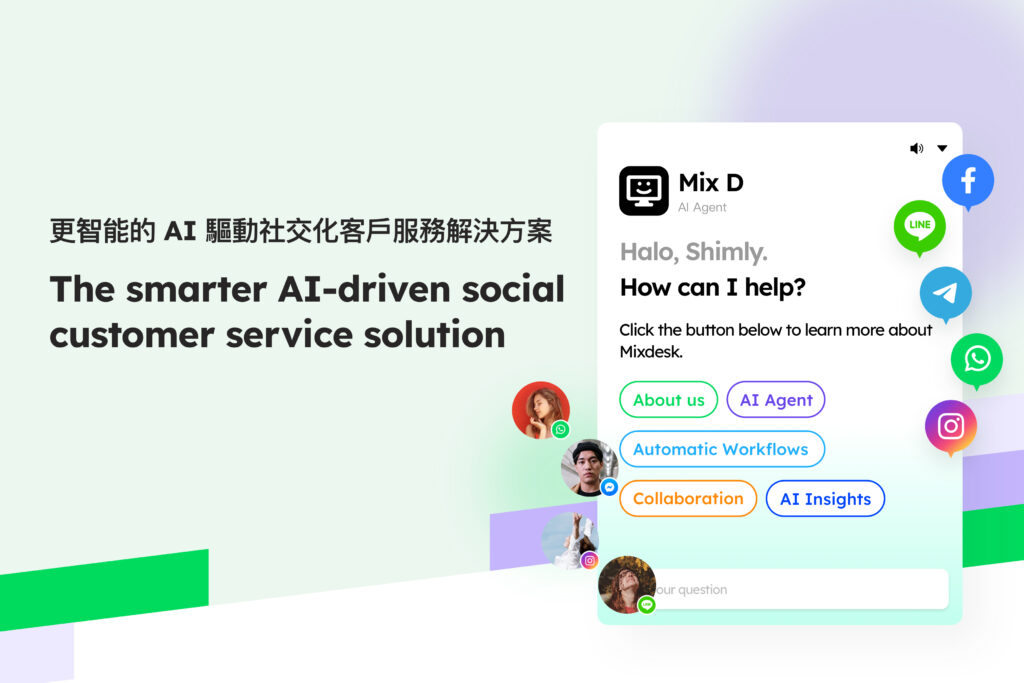
Mixdesk is an overseas multi-channel intelligent customer communication platform that can unify multiple channels such as Facebook, Instagram, WhatsApp, Line, Telegram, and Email to help companies communicate and serve customers. Mixdesk also supports AI employee functions, allowing enterprises to achieve more efficient automated customer service.
FAQ
Q1: If multiple people share a WhatsApp /social media account, will there be security and title risks?
A: The risk does not come from "multi-person collaboration”, but from “non-conforming login methods”. If you log in to the same account directly through multiple devices, it is indeed easy to trigger platform risk control. However, unified access through professional customer service systems (such as Mixdesk) is essentially “system proxy access”. If employees do not directly log in to the account body, the risk will be greatly reduced. At the same time, all conversations and customer data are concentrated in the background, which is more conducive to management and audit.
Q2: What tasks is AI most suitable for in large-scale customer service?
A: AI is most suitable for undertaking high-frequency, standardized, and well-defined service scenarios, such as frequently asked questions, basic information inquiries, etc. When AI is combined with automated processes, manual pressure can be significantly reduced, and limited manpower can be invested in transformation, complaint handling, and complex issues to achieve “amplification of collaboration efficiency.”
Q3: When is the best time to introduce a collaborative customer service system?
A: When the team has the following signals, it should seriously consider systematic collaboration: the number of customer service personnel exceeds 3-5, the customer comes from multiple channels or countries, repeated replies, missed follow-up or invisible management problems, the quality of service begins to rely on “old employees”, etc... The sooner the collaboration foundation is established, the follow-up scaleThe lower the cost of expansion.