
Author of this article:Fiona
From “being able to answer” to “understanding business”, AI is reshaping the future of customer service.
As customer communication enters a new stage of fragmentation and high expectations, it is difficult for manual customer service to solve all problems independently.:
- Cross-languageCommunication becomes standard
- Multi-channel (social media/IM/official website/email) parallel
- The service must not only be fast, but also accurately understand the intent
- Customer service must not only respond, but also promoteconversion
The “rule-triggered response” of the traditional customer service system can no longer match user expectations, and the AI-driven customer service system is evolving from an auxiliary tool to a core infrastructure for customer service experience and efficiency.
Starting from the actual needs of cross-border and growth-oriented enterprises, this article will analyze in depth the most worthy of attention in 2026. AI customer serviceSystem vendors, and analyze their respective core capabilities and applicable scenarios to help you make more robust tool selection decisions.
- 1. AI customer service in 2026 will not only answer, but also understand business.
- 2. The most worthy AI customer service system supplier in 2026
- 1. Mixdesk—Aggregation + AI-driven Customer Service Hub
- 2. Zendesk AI—enterprise-class intelligent customer service and work order collaboration platform
- 3. Intercom-Predictive Dialogue and User Behavior driven
- 4. Ada—code-free AI chat + automated reception platform
- 5. Yellow.ai -Multilingual and global AI interaction platform
- 3. How to choose an AI customer service system that matches your business?
- 4. Conclusion: The future of AI and customer service is not "more answers”, but “deeper understanding”.
- FAQ
1. AI customer service in 2026 will not only answer, but also understand business.
By 2026, companies' expectations for AI customer service are no longer just about “being able to reply automatically”, but whether they can truly share manpower pressure in complex and changeable service scenarios. In reality, the core problems faced by cross-border customer service are concentrated in several aspects: customer expression is not direct, languages are diverse, channels are scattered, problems often require multiple rounds of follow-up, and may escalate into complaints or conversion opportunities at any time. If AI can only respond based on keywords and cannot understand semantics and emotions, it will instead become a new service friction point.
Therefore, in the selection of AI Customer service systemAt that time, what companies really need to pay attention to is not “whether there is AI”, but whether AI has it.Comprehensive ability:
Mixdesk integrates top-notch big models such as ChatGPT and DeepSeek to support custom AI customer service person settings and speech skills.
High-precision response + multi-language service + automatic diversion, replacing 70% + basic consultation, and empowering enterprises around the clock.
- Can you understand the user's true intentions and perceive emotional changes to avoid misjudgment?;
- Can the response consistency be maintained in a multilingual and multi-channel environment?;
- Can it be linked with business systems such as orders, logistics, knowledge bases, etc. to directly give executable results?;
- Do you know how to return the dialogue to the labor at the right node, rather than blindly “holding on to automation”?;
- Whether each dialogue can be fully recorded, replayed and learned by the system, and the model and process optimization can be continuously fed back.
In other words, truly valuable AI customer service is no longer “answering for others."robot”, but an intelligent collaboration hub embedded in the customer service system-it undertakes repetitive work, screens high-value and high-risk dialogues, assists manual judgment, and continues to evolve as the business grows. This is the core of the vigilance and evaluation that companies should focus on when choosing an AI customer service system in 2026.
2. The most worthy AI customer service system supplier in 2026
The following is our 2026 Top5 AI customer service system suppliers evaluated based on the above competency framework, combined with market maturity, technical strength and user reputation.:
1. Mixdesk—Aggregation + AI-driven Customer Service Hub
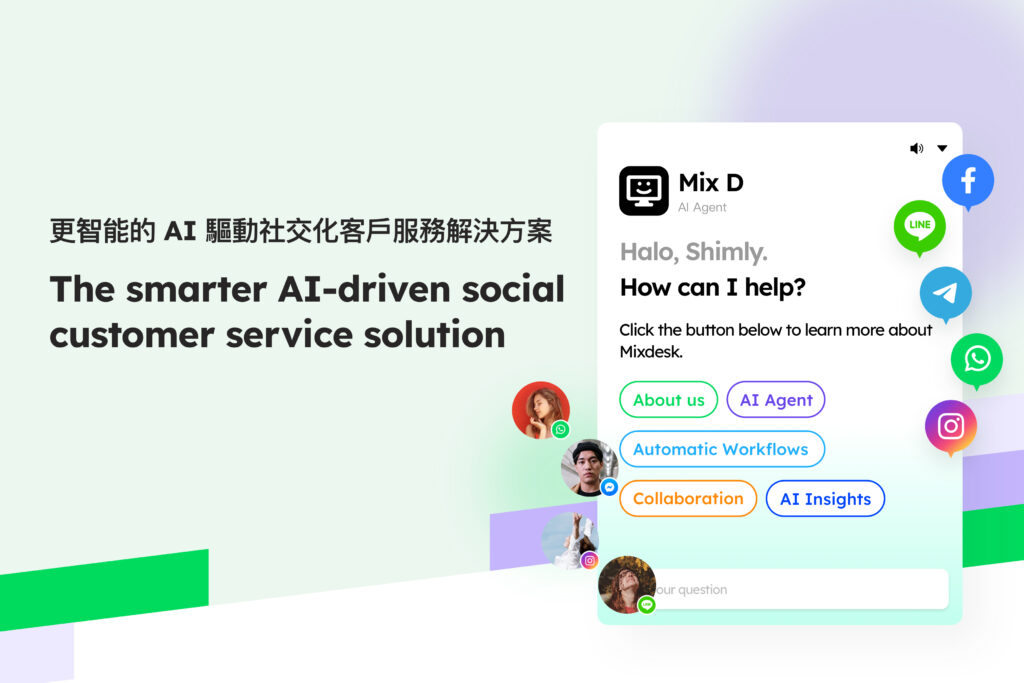
Focus on cross-channel, cross-language, and cross-module collaboration.Mixdesk Not just an AI chatbot, but a service operation center that deeply integrates AI and omni-channel communication.
Core advantages:
- Seamlessly aggregate WhatsApp, FB/IG, official website, email and other channels
- AI intelligent translation supports smooth conversion of multilingual conversations
- Intent recognition automatically determines high-value or high-risk conversations
- Systematic automated workflow and manual collaboration path
- Linkage with e-commerce platforms, ERP/CRM and other business systems
Suitable for scene:Cross-border e-commerce, overseas brands, SaaS platforms, and global customer service teams have transformed customer service from a “single communicator” to an “intelligent collaboration node”.
Use Mixdesk AI customer service system: reduce costs and save money, improve efficiency and fill up
With the help of Mixdesk, one-click deployment of ChatGPT/DeepSeek-blessed AI customer service, custom speech techniques, replacing 70% + basic consultation; data insight + one-stop operation in the background.
2. Zendesk AI—enterprise-class intelligent customer service and work order collaboration platform
Mature and robust, supporting complex work orders and cross-departmental collaboration. With the support of AI, Zendesk has upgraded the traditional work order system to an intelligent customer service collaboration platform.
Core advantages:
- AI automatic work order summary and classification
- Intelligent prioritization and SLA control
- Unified multi-channel processing and customer history integration
- Powerful reporting, analysis, and management views
Suitable for scene:A service system with enterprise-level, cross-departmental collaboration in complex scenarios, and strict SLA requirements
3. Intercom-Predictive Dialogue and User Behavior driven
Leading the application of AI in the connection layer between product and user behavior. Intercom's AI doesn't just answer questions, it can also trigger conversations based on user behavior, recognize intentions, and intelligently recommend next actions.
Core advantages:
- Behavior-triggered AI session
- Intelligent user layering and label management
- Linkage with in-product events to achieve in-depth interaction
- Automatic routing and human-computer collaboration mechanism
Suitable for scene:SaaS, application product customer service, user life cycle extension
4. Ada—code-free AI chat + automated reception platform
Emphasize business rules and visualization building capabilities. Ada provides a powerful code-free dialogue process builder, allowing enterprises to highly integrate business rules with AI dialogue.
Core advantages:
- Design of flow chart of code-free dialogue
- Automatic response to multi-channel messages
- Self-service scenario support
- Seamless switching of man-machine stages
Suitable for scene:Medium-sized teams or business lines that want to deploy quickly and have strong self-service requirements
5. Yellow.ai -Multilingual and global AI interaction platform
The ability to understand the semantics of globalization operation and maintenance and localization is outstanding.Yellow.ai The language and channels cover a wide range, which is suitable for multi-country and multi-language parallel customer service scenarios.
Core advantages:
- Support automatic understanding and generation of 100+ languages
- Covering all channels of social media/chat/enterprise applications
- Can automatically perceive time zone and regional preferences
- Support emotional and contextual understanding
Suitable for scene:Multilingual service, cross-regional expansion, global brand customer service deployment
3. How to choose an AI customer service system that matches your business?
Different AI customer service systems have their own priorities, and the one that suits you best is not necessarily the "most expensive”, butBest match your business needs and growth stage:
📌 Start-up / small team: Fast on-line, ease of use and cost priority → Mixdesk, Ada, Intercom
📌 Growth business: Multi-channel and automation capabilities are preferred→ Mixdesk,Yellow.ai
📌 Enterprise-level and complex SLA scenarios: Stability and deep collaboration are preferred→ Mixdesk, Zendesk AI
📌 Global brand: Multilingual and localization experience is preferred → Mixdesk,Yellow.ai
4. Conclusion: The future of AI and customer service is not "more answers”, but “deeper understanding”.
In 2026,AI customer serviceIt is no longer a superposition of ”auto-reply + shortcut keys", but an intelligent hub that connects understanding, collaboration, transformation and insight. A truly mature AI customer service system can not only provide a stable response in the long global service time difference, but also:
- Understand the true intentions of customers
- withBusiness dataIn-depth linkage
- Automatic diversion and ticket upgrade
- Provide managers with quantifiable quality indicators
It can be seen that in an environment of increasingly fierce global competition and increasing user expectations, choose an AI that understands business and can disassemble scenarios. Customer service system, is to build a sustainable growth path for your customer service.
Mixdesk
AI Agent
FAQ
Q1: Will AI customer service reduce the service experience?
A: If AI is used to undertake high-frequency, low-risk, repetitive problems, and to transfer labor in time at key nodes, the experience is often improved; what really slows down the experience is a “semi-automatic system” that cannot understand the context and does not allow manual takeover.
Q2: Can the translator alone meet the multilingual needs of cross-border customer service? A: Not enough. The real difficulty of cross-border customer service is not in translation, but in semantic and emotional understanding. Excellent AI customer service (such as Mixdesk) needs to maintain consistent expression in different languages, recognize the strength of tone and potential complaint signals, otherwise “you turn the right word, but you get the wrong meaning”, which will affect the experience.
Q3: When should AI be allowed to upgrade the dialogue to humans? A: When the conversation begins to involve emotional risks, business risks, or obvious values. Mature AI systems (such as Mixdesk) will not automatically answer blindly, but can proactively return conversations to humans in refund, compliance, emotional escalation, or high-potential transformation scenarios to ensure that key issues are handled correctly.