


TL;DR
From October 1, 2026, WhatsApp API service messages become billable after 1,000 free messages per business phone number each month. In-window utility templates also become billable. The 24-hour window remains, incoming messages stay free, and qualifying 72-hour entry-point delivery stays free. This guide explains the rates and preparation steps.
Source: Meta’s WhatsApp Business Platform pricing and non-template message pricing rules.
Quick Answer: What Changes on October 1, 2026?
| Message type | Through Sep 30, 2026 | From Oct 1, 2026 |
|---|---|---|
| Incoming customer messages | Free | Free |
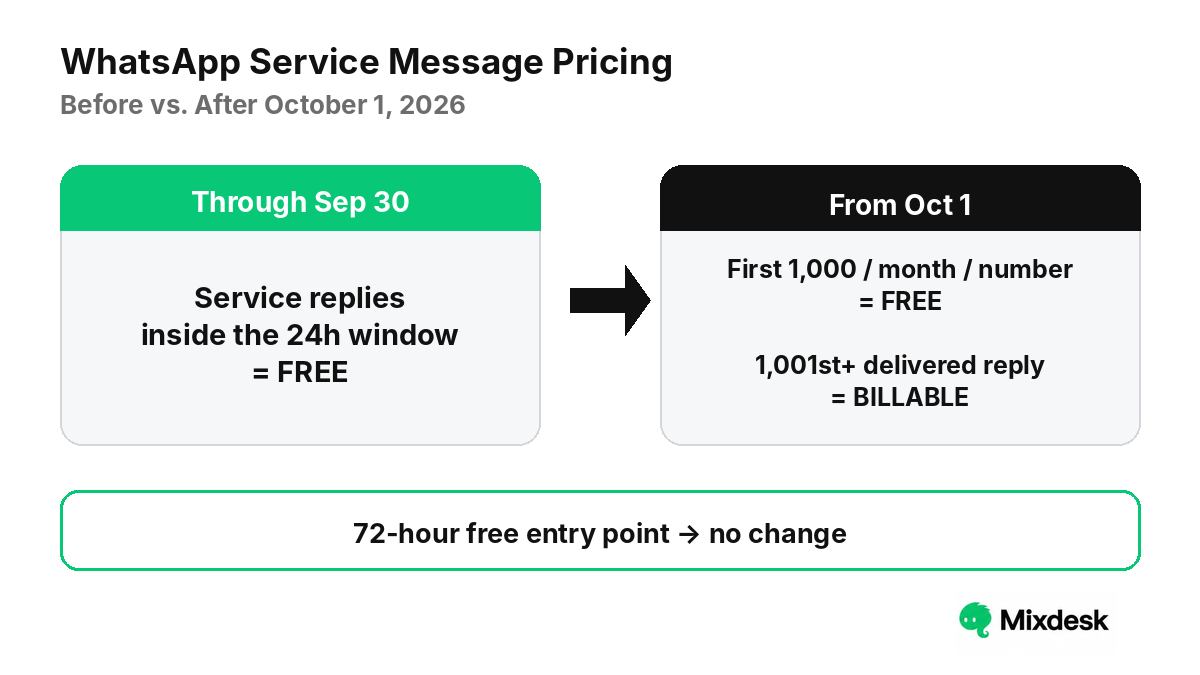
| Service messages inside the 24-hour window | Free | First 1,000/month per business phone number are free; 1,001+ are charged per delivered message |
| Utility templates inside the 24-hour window | Free | Charged per delivered message |
| Utility / authentication templates outside the window | Charged | Charged; applicable volume tiers continue |
| Marketing templates | Charged | Charged |
| Qualifying 72-hour free entry-point delivery | Free | Free for delivery; unchanged |
| Meta Business Agent messages | Token-based pricing since Aug 1, 2026 | Token-based pricing; separate from service-message billing |
What Is a WhatsApp Service Message?
A WhatsApp service message is a non-template reply sent by a human agent or third-party AI while the customer’s 24-hour service window is open. Meta Business Agent is different: it is a separate non-template category with token-based pricing.
Typical service messages include: “Let me check that order for you,” “Could you share your order number?” and “Your shipment is scheduled for tomorrow.”
From October 1, the first 1,000 delivered service messages per business phone number are free each month. The allowance resets monthly and does not roll over; after it is used, each delivered service message is billed at the rate for the recipient’s market.
Does the WhatsApp 24-Hour Window Still Exist?
Yes. The window still opens when a customer messages your business and resets when that customer messages again. While it is open, you can send non-template replies; outside it, you generally need an approved template. The October update changes the price of in-window service messages after the monthly free allowance is used, not the window itself. Read the WhatsApp 24-hour window guide for the template and follow-up workflow.
What Happens to Utility Templates?
Utility templates sent inside an open 24-hour window become billable on October 1, 2026. Templates sent outside the window were already charged, so the change removes the in-window exemption. The 1,000-message free allowance applies only to service messages, not utility templates. If your team manages templates in Mixdesk, see WhatsApp API template management.
Who Is Affected — and Who Is Not?
| Affected / changed | Not affected or unchanged |
|---|---|
| Businesses messaging through WhatsApp Business Platform/API, including official BSPs | Personal WhatsApp accounts |
| Human agents and third-party AI sending non-template replies through the API | The free WhatsApp Business app |
| Utility templates sent inside an open 24-hour customer service window | Incoming customer messages |
| High-volume support/sales teams exceeding 1,000 service messages per number/month | Qualifying 72-hour free entry-point delivery |
| Accounts without a valid payment method once messages become chargeable | Meta Business Agent remains a separate token-based category |
What About the 72-Hour Click-to-WhatsApp Free Entry Point?
Qualifying 72-hour free entry-point conversations remain free for message delivery after October 1. This applies when the conversation meets Meta’s Click-to-WhatsApp or eligible Facebook Page CTA requirements. If Meta Business Agent is used, its separate token-based charge can still apply.
How Much Will WhatsApp Business API Service Messages Cost?
There is no single global service-message price. The rate depends on the recipient’s market. Meta’s October 1 rate card aligns service-message list rates with utility and authentication rates for each market, but service messages do not receive volume-tier discounts.
Basic formula for one business phone number sending to one recipient market:
Estimated service-message fee ≈ max(monthly delivered service messages − 1,000, 0) × service-message rate for the recipient market
For multi-country traffic, apply the 1,000-message allowance once per business phone number across all recipient markets—not once per market. Calculate the remaining billable messages at each recipient market’s rate. For budgeting, use Meta’s live rate card in your WhatsApp Business Account billing currency; BSP, platform and AI fees may be separate from Meta’s messaging charge.
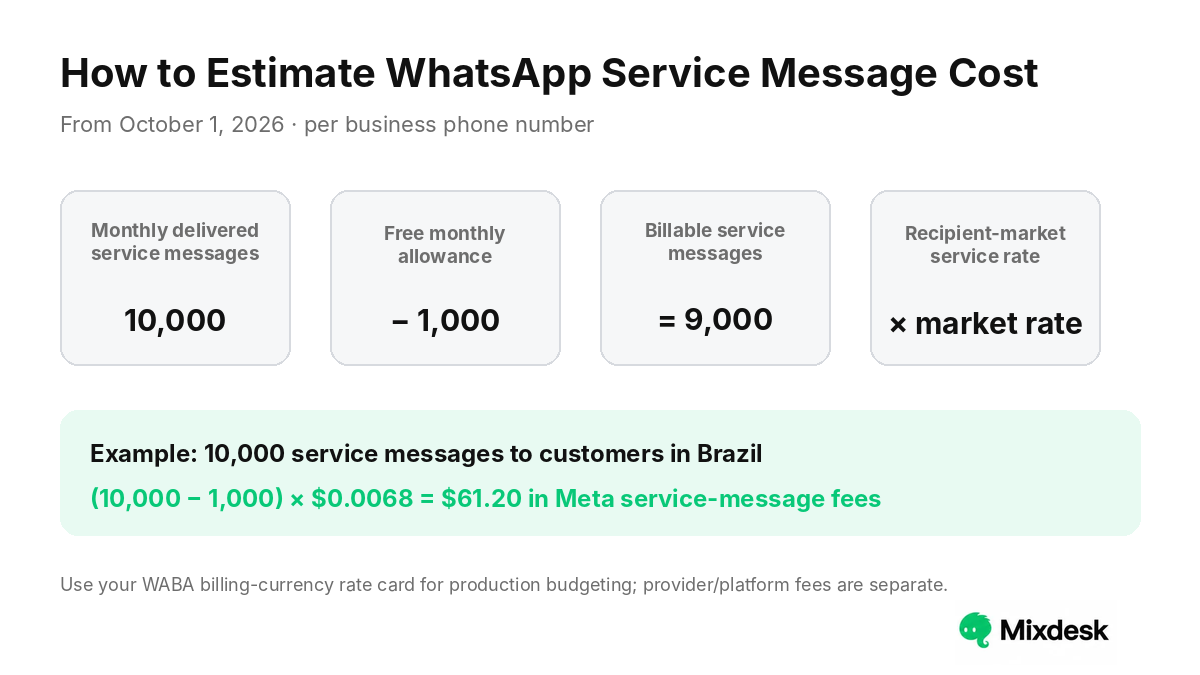
Example cost formula after applying the 1,000-message monthly free allowance.
Illustrative October 1 service-message rates
| Recipient market | Service rate (USD/message) | Cost at 10,000 service messages/month* |
|---|---|---|
| North America (US & Canada) | $0.0034 | $30.60 |
| India | $0.0014 | $12.60 |
| Brazil | $0.0068 | $61.20 |
| Hong Kong | $0.0260 | $234.00 |
| Germany | $0.0550 | $495.00 |
*Illustrative calculation assumes one phone number, 10,000 delivered service messages, the first 1,000 free, no free-entry-point exception, and the USD rate card effective Oct 1, 2026. Rates shown here were checked against the published October 1 USD rate card. Always verify Meta’s live pricing page in your billing currency before budgeting.
The September 30 Billing Hub Check You Should Not Skip
Before September 30, verify that the relevant WhatsApp Business Account has a valid payment method in Meta Billing Hub. Current implementation guidance warns that service-message delivery may stop if the required payment method is missing when the new billing model starts; YCloud’s September 2026 pricing update gives the same operational warning. Treat this as a delivery-continuity task, not just a finance task.
Before the deadline, confirm the payment method is linked to the correct WABA/business portfolio and test delivery and status webhooks.
What About AI Agents on WhatsApp?
Third-party AI agents
A non-template reply sent by a third-party AI agent is treated as a service message. After that phone number uses its 1,000 free service messages for the month, Meta charges the delivered message at the recipient market’s service rate. Your AI or software provider may also charge separately, so track total cost per resolved conversation rather than cost per AI message alone.
Meta Business Agent
Meta Business Agent is a separate non-template billing category. Since August 1, 2026, it has been priced at $2.00 per million tokens. Meta’s documentation estimates roughly 20,000–25,000 tokens for a typical reply (about $0.04–$0.05), although actual usage varies. The same Meta Business Agent reply is not also charged as a normal service message.
Why Message Turns Matter More After October 1
The cost of one reply may look small, but total cost scales with conversation volume and message turns. A support conversation with six separate business replies creates six service-message deliveries. The goal is not to send fewer messages at any cost; it is to remove unnecessary back-and-forth while preserving response quality and customer satisfaction.
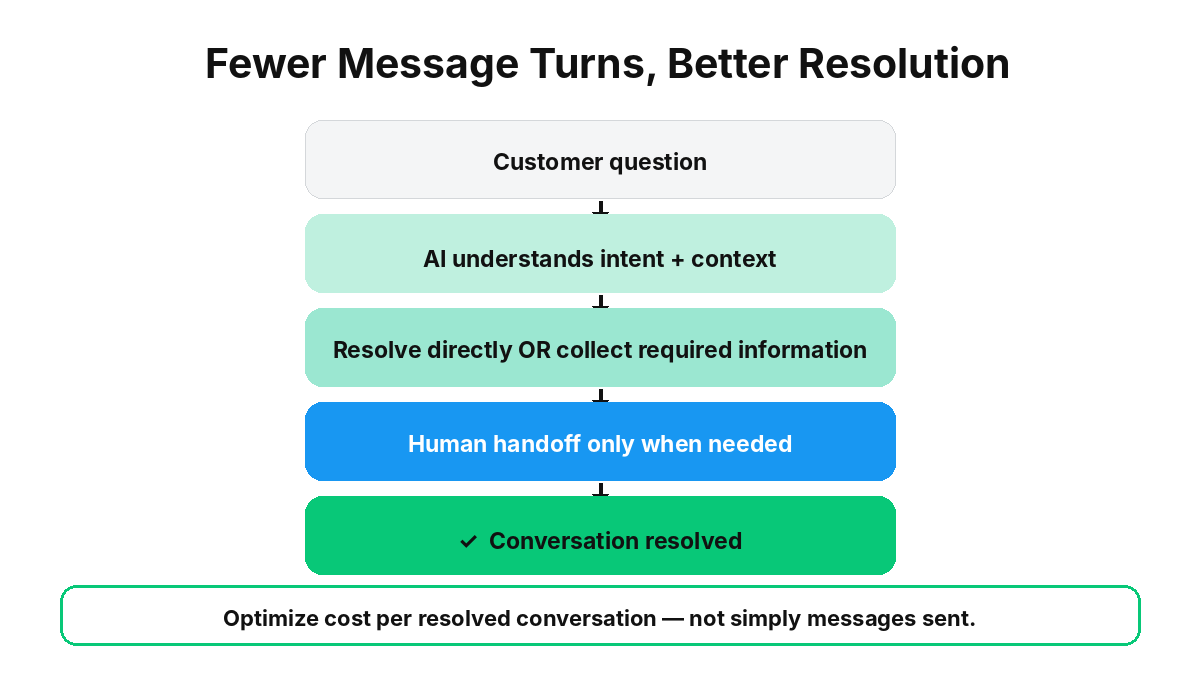
Better context and first-contact resolution can reduce unnecessary outbound message turns.
What to Do Before October 1: 6-Step Checklist
- Verify Billing Hub: Confirm a valid payment method is linked to the relevant WhatsApp Business Account before September 30.
- Measure service-message volume: Review 30–90 days of outbound WhatsApp replies by business phone number and recipient market.
- Model the new cost correctly: Apply the 1,000-message monthly allowance per phone number, then use the recipient-market rate for the remainder.
- Audit in-window utility templates: Identify utility templates that are currently free only because they are sent inside the 24-hour window.
- Reduce unnecessary turns: Improve first replies, collect required information earlier, and pass full context into AI-to-human handoffs so customers are not asked to repeat themselves.
- Track total cost per resolution: Compare Meta messaging fees, AI/model costs and platform fees against resolution rate, response time and conversion.
How Mixdesk Helps Teams Adapt
Mixdesk can connect a WhatsApp Business API account to a shared service workspace, where teams can use Mixdesk AI Agent, automation workflows and team collaboration to collect information earlier, route exceptions and hand conversations to humans with context. Mixdesk does not change Meta’s rates or replace Meta Billing Hub.
Teams can also manage approved WhatsApp API templates and keep customer context in an omnichannel workspace alongside email, web chat, Facebook, Instagram, LINE and Telegram. These workflows can help reduce duplicate replies and unnecessary back-and-forth while keeping handoffs consistent.
Frequently Asked Questions
How does WhatsApp Business API pricing work from October 1, 2026?
Service messages become per-delivered-message billable after 1,000 free service messages per business phone number each month. Utility templates sent inside the 24-hour window also become billable. Template and service rates depend on the recipient market.
Does the WhatsApp 24-hour window still exist, and are utility templates still free inside it?
The 24-hour window still exists and still controls when non-template replies are allowed. However, utility templates sent inside the window become billable on October 1, and service messages become billable after the phone number’s monthly 1,000-message allowance is used.
How does the 1,000 free service-message allowance work?
The allowance is per business phone number, per month. Charging starts with the 1,001st delivered service message for that number. Unused free messages do not roll over.
Does this affect the free WhatsApp Business app?
No. The October service-message pricing change applies to the WhatsApp Business Platform/API used for software-connected business messaging. The regular WhatsApp app and free WhatsApp Business app are not billed under this API service-message model.
How are AI replies charged?
Third-party AI non-template replies are service messages, so the 1,000-message allowance applies before per-message charging begins. Meta Business Agent is separate and uses token-based pricing; the same reply is not charged under both categories.
Is the 72-hour Click-to-WhatsApp window still free?
Yes for eligible message delivery when the conversation qualifies for the free entry-point window. Meta Business Agent token charges can still apply because Meta’s agent has its own pricing category.
What happens if I do not add a payment method by September 30?
Current provider guidance says service-message delivery may stop if the required payment method is not added before the new pricing starts. Because implementation notices do not all describe fallback behavior the same way, the safe operational assumption is to configure and verify Billing Hub before September 30 rather than relying on the monthly free allowance.
Prepare for WhatsApp’s October Pricing Change
Before October 1, check Billing Hub, establish your service-message baseline and identify high-turn conversations that can be resolved more efficiently.
Start a free Mixdesk trial to explore the shared workspace, or compare Mixdesk plans and features.